
Intelligence Quotient (IQ) is a measure often used to assess a person’s cognitive abilities compared to others their age. While IQ scores can vary slightly with age, the average IQ remains fairly consistent across different age groups due to the way IQ tests are designed. Let’s break down the average IQ by age, specifically focusing on boys aged 11 to 14.
Understanding How IQ Is Measured
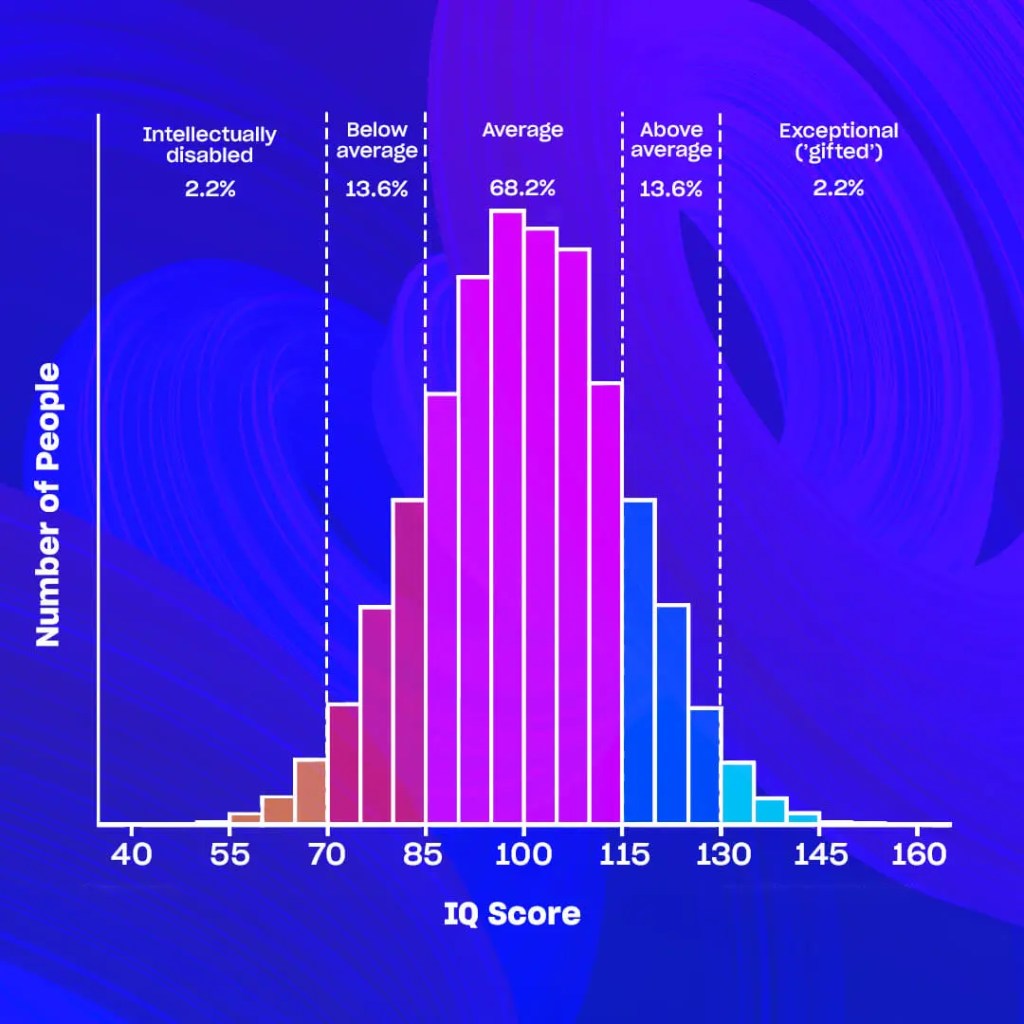
IQ tests are designed so that the average score for any age group is set at 100. This score represents the median cognitive ability, with the majority of people scoring between 85 and 115. These scores are typically distributed in a bell curve pattern. Standardized tests like the Wechsler Intelligence Scale for Children (WISC) are commonly used to assess the IQ of children.
IQ doesn’t only measure knowledge or academic performance—it includes reasoning, problem-solving, memory, and verbal understanding. Environmental factors, education level, nutrition, and family background can also influence IQ.
Average IQ for a 12-Year-Old Boy
A 12-year-old boy, like any child tested for IQ, is compared to others in the same age group. The average IQ for a 12-year-old is around 100, which is the baseline across all age groups. Most children in this age range will score between 85 and 115, which is considered normal or average intelligence.
At this age, cognitive development continues to grow steadily. Boys often show strong improvements in memory, logical thinking, and verbal reasoning—skills commonly evaluated in IQ tests.
Average IQ for an 11-Year-Old Boy
Just like with 12-year-olds, the average IQ for an 11-year-old boy is also 100. IQ tests are adjusted for age, so the score reflects how well a child is performing compared to peers. This means an 11-year-old who scores 100 is performing at the same level as the average 11-year-old.
Children at age 11 are often in late elementary school or early middle school. Their IQ scores may reflect developing language skills, math ability, and spatial reasoning.
Average IQ for a 13-Year-Old Boy
The average IQ for a 13-year-old boy remains 100. However, individual scores can start to show more variation as students begin to specialize in certain subjects or show specific interests. A score between 90 and 110 is still considered average for this age group.
At 13, many boys are experiencing more rapid brain development. Problem-solving, abstract thinking, and comprehension skills may improve, but overall IQ scores are still expected to fall within the same standard range.
Average IQ for a 14-Year-Old Boy
At 14, the average IQ score continues to be 100. While teens may develop advanced skills in certain areas, the IQ test is still calibrated for their age. This means a 14-year-old with an IQ of 100 is at the average level for other 14-year-olds.
By this age, boys are often capable of higher-level thinking and analysis. However, this growth is reflected more in school performance and maturity than in a shift in average IQ scores.
Final Thoughts
IQ is just one way to measure intelligence, and it should not be used as the sole indicator of a child’s ability or future success. The average IQ score of 100 applies consistently to 11, 12, 13, and 14-year-old boys. Differences in test scores can depend on many factors, but most children fall within a healthy, average range. What truly matters is how children apply their strengths, stay curious, and continue to learn.
 What is the Average IQ for a 12 Year Old Boy (and 11 Year Old, 13 Year Old, 14 Year Old)